
This year marks the tenth edition of Pagsalingoy, Calabanga’s annual cultural presentation as it celebrates the 277th Town Fiesta. What better way to celebrate a decade of showcasing Calabangueño traditions than by turning the pages of the past and revisiting the performances of cultural heritage that shaped the community?

Together with Central Bicol State University of Agriculture (CBSUA)-Calabanga, Sentro ng Artistikong Manlilikha na Bumubuo ng Identidad at Talento (SAMBIT), SAMBIT Alumni Association (SAMBIT-AA), Calabanga National Science High School Special Program for the Arts (CNSHS-SPA), Divine Mercy Youth Council (DMYC), Calabanga Senior Citizens Choir and Dance Group, and the Local Government Unit of Calabanga, Calabangueños once again relived, relearned, and rediscovered the stories that have shaped the community’s cultural identity on September 4, 2026, at the Calabanga People’s Octagon.
At the heart of this year’s presentation were three generations: the Lola, who carried the memories of yesterday; the Bata, who asked questions about the past; and the Kabataan, who recounted the stories of previous Pagsalingoy performances. The Bata, curious about the script that his ate, the Kabataan, was preparing to perform, asked a simple question: Ano po an Pagsalingoy?

Lola answered with a memory. Pagsalingoy, she explained, is a celebration of Calabanga’s cultural heritage, a collection of songs, dances, stories, traditions, and practices that have helped define the identity of the municipality and its people. But knowing what Pagsalingoy is was only the beginning. Taking the lead, the Kabataan recounted the story, and took the audience on a journey through the history of Pagsalingoy.
The Kabataan traced how the cultural presentation began and introduced the people and organizations that helped bring it to life. The year was 2017, when the LGU and CBSUA-Calabanga called for people who shared the goal of promoting Calabangueño heritage. Local cultural organizations and elementary and secondary schools responded. Filipino songs and dances, such as the Pantomina, were featured. Similarly, Bahon, a Calabanga courtship and marriage tradition, became the highlight of Pagsalingoy’s first year.

Meanwhile, the 2018 edition focused on Calabanga’s origins and the people’s primary sources of living at the time, such as pagtiklad nin nipa, pagsaka, and pagsira.
In its third year, ten local composers were recognized for their contributions to Calabanga’s music through Kanta Calabanga. Alicia Del Puerto was honored for writing Calabanga March, while Arnold Logoc was recognized for his compositions Saro sa Pagtubod, Saro sa Pag-asenso and Himno ni Inang La Porteria.
In between these stories of its early years, performances from different cultural organizations brought Pagsalingoy’s history to life. Much like the three generations, the performers themselves represented generations coming together to remember and celebrate Calabanga’s heritage.

The CNSHS-SPA dancers and instrumentalists showcased their talents through Pasigin, a folk dance that mimics the movements of catching fish with ring nets. SAMBIT followed with Agogocoy, a crab folk dance, while the DMYC presented Ginik, a folk dance depicting the lives of farmers from planting to harvest. Through these performances, the youth did more than recreating traditional dances. They gave movement to the stories of the livelihoods that have sustained Calabangueño communities for generations. The CNSHS choral group then sang Isarog, a song about the mountain that covers parts of Calabanga, while Municipal Councilor Hon. John Oliver Tabinas serenaded the audience with a Bikol harana.

The Calabanga Senior Citizens Choir and Dance Group then offered a different kind of reminder to the younger generation through their rendition of the Bikol song, Si Nanay, Si Tatay. Their performance became a gentle message that preserving culture is not only about remembering traditions but also about remembering the people who passed them on to us.
Then came 2020, when the COVID-19 pandemic brought the fiesta and many cultural activities to a halt. Yet Pagsalingoy found a way to continue. Moving beyond the physical stage, it turned to social media and online conferencing, launching the CBSUA CARES webinar featuring the SALIKHA Creative Grant, Sarong Aldaw: Retelling Bikol Heritage, a CBSUA project funded by the Commission on Higher Education and the National Commission for Culture and the Arts. SALIKHA, a combination of saliksik (research) and likha (create), emphasized how research can uncover stories worth telling, while art can give those stories new life and make them accessible to a wider audience. Calabangueño writers, including Bernardo Aguay Jr., Dan Albert Cariño, Edna Campana, Jerome Hipolito, and Edwin Breva Jr., were also recognized through Surat Calabanga.

Then, in 2021, still using online platforms, Pagsalingoy looked back on its first five years. Calabangueño educators, including DepEd Public School District Supervisor Mrs. Zenaida T. Bonete and former Calabanga National School of Arts and Trades administrator Mr. Eliseo H. Lachica, were posthumously recognized for their contributions. The year also featured Kurit Calabanga, which showcased and recognized local visual artists.
Performances returned to the stage in 2022, bringing with them another story from Calabanga’s cultural memory. This time, Pagsalingoy featured Kami Kaidto, a play depicting traditional courtship and marriage practices in Calabanga. More than a portrayal of customs from the past, the play told a story of resilience, love, and sacrifice. What made the story even more meaningful was its grounding in lived experience. Kami Kaidto was based on the experiences of Lola Socorro Hernandez, whose memories served as the primary source for the play. Through her story, personal memories became part of the community’s collective memory.

Another play that brought a chapter of Calabanga’s history to the stage was presented in 2023. Odang, a story about a mother’s love, was set during an epidemic in the American era in the Philippines. Beyond portraying a difficult period in the community’s past, the play explored the struggles of a mother confronted with uncertainty. At its heart was a question beyond its historical setting: Is deep faith enough for a person to understand what God wants to convey?
Sabang, a coastal barangay in Calabanga, became the setting of the stage play in 2024. The story followed a young man, Luis Jr., who rose before dawn to venture out to sea to earn a living for his family. It featured Bulungan, a traditional livelihood practice associated with fishing and trading that reflected the community’s deep connection to the sea. Yet the story did not end with hardship. It carried a hopeful message through this young man, who despite the challenges he encountered, eventually grew up to become an engineer. His success became more than a personal achievement. It became a way of giving back to his parents and to the community that shaped him. Bulungan thus became a story about roots, perseverance, and the responsibility to remember and honor where one came from.

In 2025, Pagsalingoy turned once again to faith with Amang Hinulid, a story depicting how people turn to God in times of hardship. It featured the sacrifices made during Lent, including long walks as acts of penance and the lighting of candles as symbols of prayer, light, and hope.
After each narration of a previous Pagsalingoy edition by the Kabataan, parts from the plays were brought to the stage. The performances transformed the stories she had recounted into living memories before the audience. What had once been performed in different years was brought together in a single presentation. This allowed one generation to remember, another to rediscover, and the next to inherit the stories of Calabanga.
In the end, the Bata came to understand that Pagsalingoy is more than a show. It is a way of knowing the lives that came before and understanding the lives we live today. Lola reminded him that culture does not end in the past. It lives on in the present and finds its future in the young. It is the youth of today who will not only remember these traditions but also carry them forward, practice them, and give them new life for generations to come.
Pagsalingoy 2026 ended with a procession honoring Nuestra Señora de la Porteria, the patron saint of Calabanga. The celebration then concluded with the singing of Sarong Banwan, Sarong Simbahan, a song that reflected the enduring connection between the community and its faith. After a journey through a decade of memories, traditions, stories, and performances, the celebration returned to where much of Calabanga’s identity is rooted: in its people, its community, and its faith.

Pagsalingoy’s writer-director Dr. Rosa Ubano-Cid call to the youth echoed beyond the stage, “Yaon sa saindong kamot an pagpadagos kan satong kultura, dahil dae nindo mapaplano an bukas kun dae nindo sasalinguyon an suodma.”
Since 2017, Pagsalingoy has brought to life stories of Calabanga’s past as told by its people. Year after year, these stories have become more than a collection of performances. They have become pieces of a collective memory and stories that help the community understand its roots, values, struggles, faith, and identity.
The performances from 2017 through 2025 converged on one stage in 2026 not simply to revisit what had been, but to remind Calabanga that every story leaves something. And perhaps this is what it means to look back, to salingoy: to return to where we came from so we may know what is worth keeping, what is worth carrying, and what must live on.
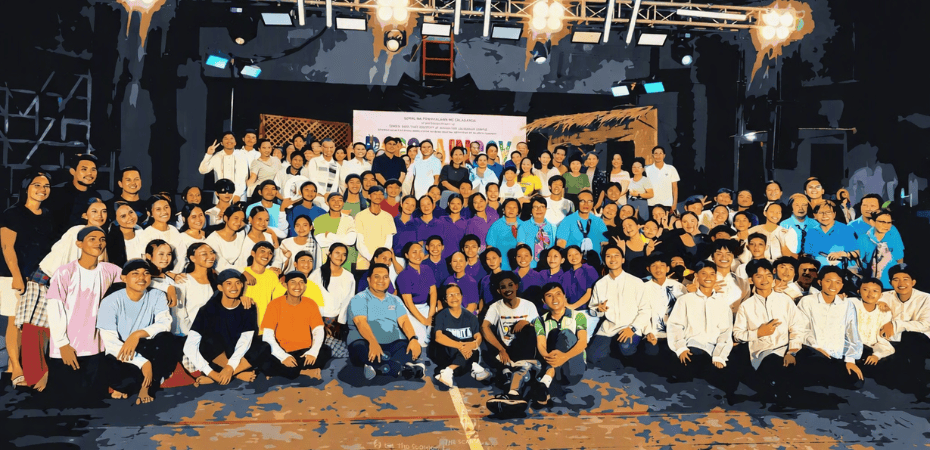
The header features a posterized photo of the Pagsalingoy 2026 performance and production group. (credit for all photos in this piece: The Scanner, official campus publication of CBSUA-Calabanga)
About the author

Edwin S. Breva, Jr. is an educator from Calabanga, Camarines Sur. He currently teaches at Central Bicol State University of Agriculture-Calabanga Campus. He helped organize several writers workshops, including Saringsing Writers Workshop, CBSUA Writers Workshop, and San Miguel Writers Workshop.